
You're Living in Two Worlds Right Now
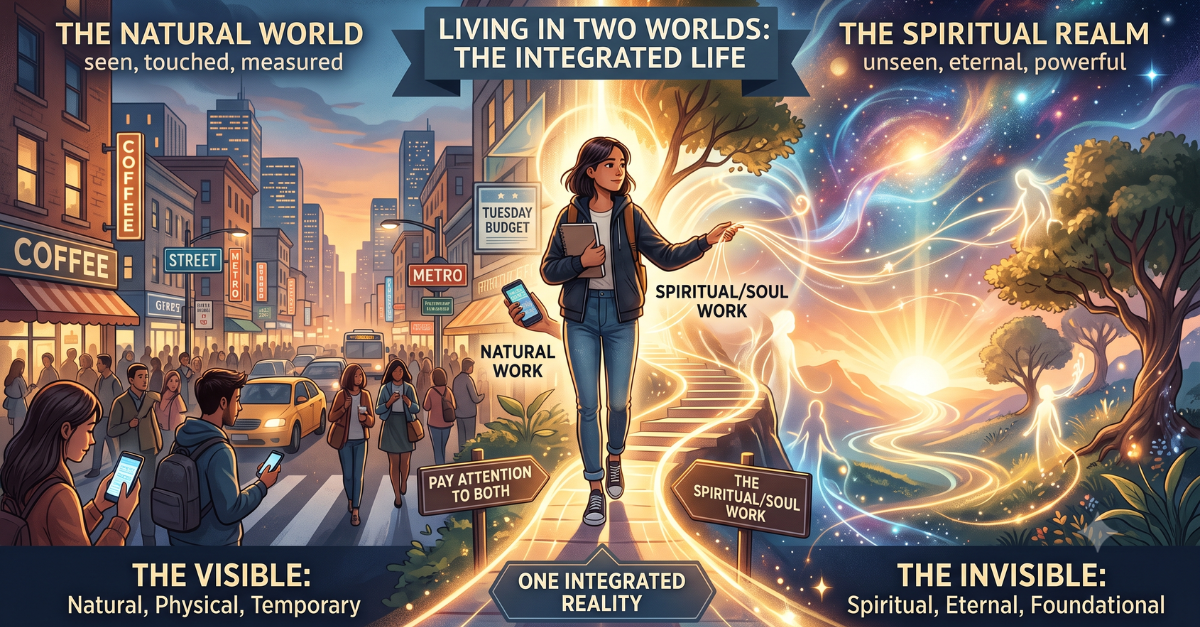
I came across a quote from John Eldredge's Wild at Heart a few weeks ago.
"As a Christian, I believe that we live in parallel worlds."
It's something I think we can easily forget.
Most of us in the West were shaped by a worldview that splits life into two categories. There's the stuff you can see, touch, and measure. And then there's the spiritual stuff, which we file away as a separate, softer, less certain category. Nice for Sunday. Not particularly relevant on Tuesday when the budget is short or the staff meeting goes sideways.
But that's not the world the Bible describes.
Genesis to Revelation shows one integrated reality, not two competing ones. Hebrews puts it plainly. The Son is "sustaining all things by his powerful word" (Hebrews 1:3, NIV). Not some things. All things. And "what is seen was not made out of what was visible" (Hebrews 11:3, NIV). The natural world you're standing in right now was formed by something you can't see. That's not a claim, that's actual reality.
We just don't tend to think about it much. We're wired to trust our five senses and treat everything else as theoretical.
The Conversation With Nicodemus
Jesus had this exchange with Nicodemus that gets at exactly this tension. Nicodemus comes to him with religious knowledge and good questions, and Jesus tells him he needs to be born again. Nicodemus is confused, so Jesus says something almost frustrated.
"But if you don't believe me when I tell you about earthly things, how can you possibly believe if I tell you about heavenly things?" (John 3:12, NLT)
In other words, if you can't track with what's right in front of you, how are you going to track with what's invisible? And then, "No one has ever gone to heaven and returned. But the Son of Man has come down from heaven" (John 3:13, NLT). Jesus is the only one who has ever stood in both worlds at once. He's not describing two separate realities to us. He's describing one reality that most people only ever see half of.
Your body is natural. Your spirit is spiritual. Your soul is both, holding them together. You are, right now, a walking example of the integrated world you were made for.
What I've Watched Happen
I know you'll find this hard to believe, but there is conflict even when you're on staff at church. Sometimes more so in a church. And there's a pattern I've seen enough times that I trust it completely.
We don't fight against flesh and blood. That's not a nice sentiment. It's a diagnosis. Time and again, in the middle of a real, natural, human conflict, I would sense there was more going on than what I could see on the surface. So I'd do some soul work and see if I was bringing anything to the situation. And I'd pray into the situation, not a generic prayer, but something specific to what was happening, asking God to reveal anything that was spiritually underneath it.
And almost immediately, things would start to shift.
Not always instantly. Not always dramatically. But consistently. The work always had to happen in both realms. But when the spiritual side got addressed, the natural side became possible in a way it wasn't before. Conversations that felt stuck would open up. People would soften. Paths forward would appear that weren't there the day before.
That's not superstition. That's what it looks like to actually believe we live in one integrated world instead of two disconnected ones.
The Assumption That's Costing Us
Here's what I think we get wrong most often. We assume the natural and spiritual are separate, when they're interconnected and overlapping. That's assumption one.
Here's assumption two, and it's the one I think does more damage. We lean so hard on God's sovereignty that it turns into apathy. We tell ourselves God will just take care of it, so we don't have to engage. But most of the time, there's a part only he can do, and a part only we can do. It's a partnership. We are his body. He moves through us. Sovereignty was never meant to be an excuse for passivity.
When the Way You Think Becomes the Problem
There's a difference between what I think, the actual content of my beliefs, and how I think, the lens I process everything through. My friend Bob Hamp talks extensively about this in his book Think Differently, Live Differently. A lot of this article is shaped by truths I first picked up from him, and it's had a profound impact on how I lead.
Bob always shared that the Pharisees are the clearest example of this in scripture. They knew the Bible better than anyone in their generation. But the way they knew it brought death instead of life, both to them and to the people around them. The trap for us is if we think we have the right way, we already have the wrong way.
I've felt this personally. Rejection is a lens I've had to watch closely in my own life. Once it's in place, you start filtering every interaction through it, and you can end up seeing rejection where none actually exists. Someone doesn't respond to a text right away and suddenly you're building a case against them in your head. That's not discernment. That's a distorted lens doing what distorted lenses do.
This is what Jesus was actually getting at when he said repent, for the kingdom of heaven is at hand. He wasn't handing out a new behavior checklist. He was saying, change the way you think. Heaven isn't far away. It's close enough to reach out and touch.
And then he goes and reinterprets one of the Ten Commandments to prove it. "You must not murder... But I say, if you are even angry with someone, you are subject to judgment" (Matthew 5:21-22, NLT). Jesus had a completely different way of knowing what that commandment meant than the religious experts of his day did. Same words. Different lens. Different result.
Pay Attention to Both
We're trying to know eternity. We're trying to understand a spiritual reality and a God we can't see or prove with science. Given all that, we should probably expect to be a little humbled by how many of our assumptions about Christianity turn out to be tradition rather than truth. Things we picked up from being around other believers, not from the text itself.
So here's where I'd land. Don't spend your energy trying to pick a side between the natural world and the spiritual one. You don't get to choose. You already live in both. The invitation is just to start paying attention to both realms instead of only the one you can measure with your five senses.
The next time you're in a conflict that feels bigger than it should, or stuck in a place that isn't moving, ask what's happening beneath the surface too. Do the natural work. But don't skip the soul work and the spiritual work. In my experience, that's usually the part that unlocks everything else.